Editorial content — for general information
The Ophthalmologist's Journal
Practical notes on macular health — by Dr Julien Marchal, ophthalmologist
HomeHealthWellnessReviews


Visual health & prevention
AMD: the complete guide I give to my patients
"This notebook brings together, in detail, everything I usually explain to my patients about AMD — the forms, the stages, the signs to watch, what the research says, what people with it actually experience. I keep it up to date so everyone can understand it, calmly, what there isn't always time to detail in a fifteen-minute appointment."
Updated {published} · about 14 minutes' reading
What AMD isDry or wetThe 3 stagesThe symptomsEveryday lifeRisk factorsScreeningNutrition researchWhy act nowMy daily advice
What is AMD, exactly?
Age-related macular degeneration is today the leading cause of low vision in people over 50 in Western countries, and the leading cause of visual impairment after 60.
The macula is a tiny area, a few millimetres across, at the centre of the retina. It's what lets you read, recognise a face, drive, or make out fine detail — everything called central vision. The rest of the retina handles peripheral vision, the part that lets you move around without bumping into furniture.
- 1.5Mpeople affected in France
- 1 in 4of those over 75 are concerned
- 1 in 8of those over 60 are concerned
- 3,000new cases of blindness a year
Source: national health institute, AMD file
What I always point out
AMD never causes total blindness in the sense of complete darkness. It takes away central vision, and leaves peripheral vision intact. Knowing that changes how people live with the diagnosis.
Dry AMD and wet AMD: two diseases, two speeds
This is one of the first things I clarify with my patients, because the two forms don't progress the same way at all.
The dry form is the most common (about 80% of cases) and progresses slowly, over years. The wet form is rarer but faster: abnormal vessels grow under the retina and can distort vision in weeks.
Treatment differs radically: the wet form is treated with injections; for the dry form, there is no treatment today, and everything rests on slowing it down and on prevention.
Good to know
Both forms can coexist in the same person, sometimes differently in each eye. Which is why follow-up is done eye by eye.
Early, intermediate, advanced: why the stage changes everything
The first thing I look at during a fundus exam is the drusen — small yellowish deposits that build up under the retina.
- Early stage: a few small drusen, most often without any symptom. This is the stage at which prevention matters most.
- Intermediate stage: more or larger drusen. Slight visual distortions may appear.
- Advanced stage: the disease tips into an atrophic dry form or an exudative wet form, with an impact on central vision.
What the research shows
It is precisely at the intermediate stage that the large clinical studies on nutrition (AREDS, AREDS2) observed a benefit from a targeted intake of macular carotenoids and antioxidants.
The signs I ask my patients to watch for

The trap of AMD is that it's often silent at first. Here are the signs I ask my patients to watch for:
- Straight lines that look wavy or broken (a door frame, tiles, the lines of a page).
- A blurred or dark patch in the centre of the visual field.
- More difficulty reading, needing more light or bigger letters.
- Colours that seem less vivid than before.
- Difficulty recognising faces at a distance, while a person's walk or outline is still clear.
Faced with any of these signs, even a discreet one, my rule is simple: better one exam too many than one too few.
The test I recommend at home
The Amsler grid. One eye at a time, at reading distance, with your glasses on: fix the central dot and check that the lines stay straight. Once a month is enough.
What my patients tell me, beyond the numbers

Statistics don't tell the whole story. What has struck me most over the years is how much AMD affects independence: reading a letter, driving, recognising a grandchild's face across a room.
Beyond the visual loss, my patients often describe a loss of bearings, and a fear of becoming dependent. That is also why I keep returning to the same message: the earlier you act — screening, lifestyle, nutrition — the more you keep.
The risk factors I repeat at every consultation

Some risk factors can't be argued with: age and heredity. Others can be managed.
- Smoking remains the heaviest modifiable factor.
- Heredity weighs strongly: having an affected parent raises the risk considerably.
- Excess weight raises it too, probably through the chronic inflammation it maintains.
- Unprotected sun exposure over many years is also cited as an aggravating factor.
What I recommend stays simple: stop smoking, watch your weight, have your blood pressure and blood sugar followed, protect your eyes from the sun.
And screens in all this?
The blue-violet wavelengths emitted by screens and LEDs are discussed as a possible factor in oxidative stress of the retina. The evidence is still being gathered; in the meantime, breaks, distance and good lighting cost nothing.
Why I insist so much on regular screening
AMD often progresses in silence. At the early stage, it usually causes no visible discomfort — which is exactly why an exam after 50, even without symptoms, is the best investment a patient can make.
Alongside regular follow-up, looking after one's intake of macular carotenoids and antioxidants is part of what I discuss with every patient at risk.
What nutrition research really shows

This is the subject I'm asked about most often, and the one where the research is most solid.
The large AREDS2 study looked at what a targeted intake of lutein and zeaxanthin — the two pigments naturally concentrated in the macula — changed for people at the intermediate stage. To those two, meso-zeaxanthin, the third pigment found at the very centre of the macula, is now added in most formulas.
These pigments are not made by the body. They come from food, or from a supplement.
What AREDS2 showed
Replacing beta-carotene (which is not recommended in excess for smokers) with lutein and zeaxanthin was associated with a lower risk of progression to the advanced stage in the follow-up of the study's participants.
Why my patients take action now, and not later

It's almost never a number or a statistic that decides my patients to finally look after their macula. It's one of these:
- Keeping their independence: driving, reading their own papers, doing their shopping alone.
- A family history: having watched a parent lose their sight changes how you look at your own.
- Continuing to recognise loved ones: seeing a grandchild's face clearly remains, for many, the real motivation.
- Eyes put to the test by screens: many of my patients, working or newly retired, spend their days in front of them.
What I recommend, very concretely, to my patients
Over the consultations, I keep returning to the same simple markers — the ones I'd give a member of my own family:
- Favour a diet rich in leafy greens, corn, peppers, eggs and oily fish.
- Don't smoke, and get help to stop if needed.
- Watch your weight, blood pressure and blood sugar.
- Protect your eyes from the sun with good filtering glasses.
- Have your eyes checked regularly after 50, even without symptoms.
- Do the Amsler grid test at home, one eye after the other, once a month.
It's this whole — diet, lifestyle, screening and a targeted intake of carotenoids — that, in my experience, gives patients the best chance of keeping their central vision for a long time.
aura — Macular complex
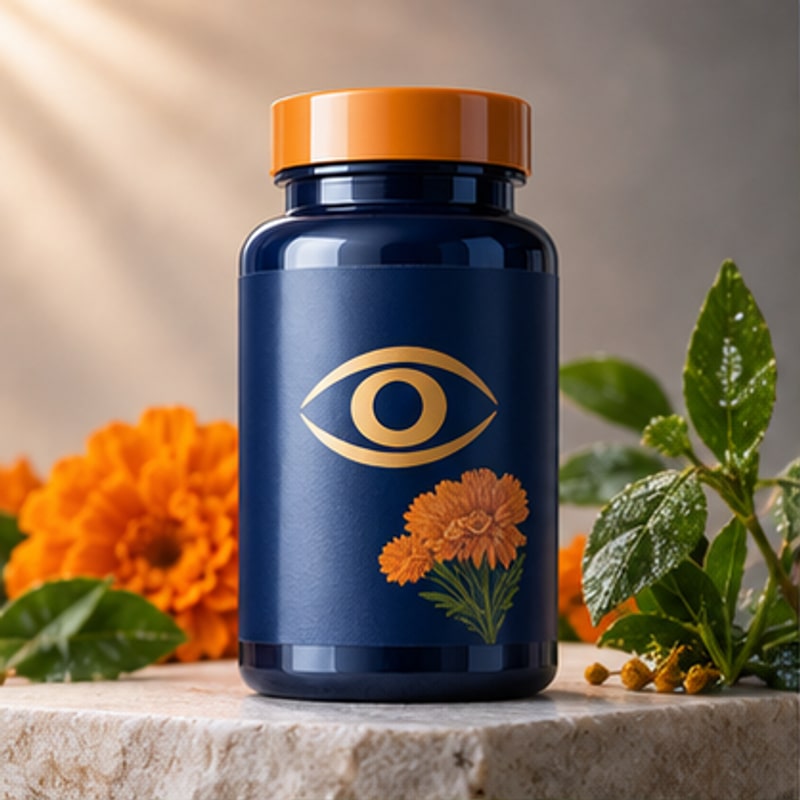
Lutein, zeaxanthin & astaxanthin, together
★★★★★ Rated 4.8/5 on 2,400+ reviews
GET -35% today 👇 · 90-day guaranteeDeal ending in02:45:57
Lutein + zeaxanthin + astaxanthin complex, no beta-carotene15 actives in a single plant capsule a day
Made in France · Non-GMO · Vegan
What our customers say
What customers are saying
FAMILY HISTORY
My mother lost her sight to AMD. Since then I do everything not to relive it: an exam every year, and this formula every morning. My ophthalmologist knows about it and approves.
Michel D., 67Verified purchase
SCREENS ALL DAY
Ten hours a day on a screen. Less end-of-day fatigue after a month, and the feeling of doing something rather than waiting.
Claire V., 58Verified purchase
INTERMEDIATE STAGE
Diagnosed at the intermediate stage two years ago. My doctor mentioned the AREDS2 formulas; this one has the three pigments. Easy to take, no aftertaste.
Bernard L., 72Verified purchase
What my patients ask me most often
Is AMD hereditary?
Heredity is one of the strongest factors: having an affected parent raises your own risk considerably. It makes screening after 50 all the more important; it doesn't make the disease inevitable.
Can a supplement replace the injections for wet AMD?
No. Wet AMD is treated with injections prescribed and given by an ophthalmologist. A supplement is a complement to a lifestyle, never a replacement for a treatment.
From what age should I think about it?
Screening from 50, earlier with a family history. A targeted carotenoid intake is discussed case by case, most often from the intermediate stage or with identified risk factors.
How long before there is any effect?
Macular pigment builds up slowly: the studies measured changes over months, not days. Take it every day, and keep your follow-up appointments.
EXCLUSIVE
-35% online discount
The offer is in high demand and we cannot guarantee stock, which regularly sells out.
Claim the discount and check availabilityThis special offer is valid until today at {time}02:45:57
Sell-out risk: HighFREE shipping
Try it today with a 30-day money-back guarantee!

A question after reading this?
This notebook does not replace a consultation. If you have questions about your vision, talk to your ophthalmologist. And if you have a question about the formula, our team answers every message.
Sources & scientific references
- Age-Related Eye Disease Study 2 (AREDS2) Research Group. Lutein + zeaxanthin and omega-3 fatty acids for age-related macular degeneration. JAMA, 2013.
- National Eye Institute (NIH). About the AREDS and AREDS2 clinical trials.
- AREDS2 Report 28. Long-term outcomes of adding lutein/zeaxanthin to the AREDS formulation.
- Add here the publications on the nutrients in your own formula, and your national health institute's page on AMD.
These publications concern the nutrients studied (lutein, zeaxanthin, meso-zeaxanthin) and the disease in general; they are not studies of this product.